AI Infrastructure Guide
AI Inference Infrastructure: What Actually Drives Cost and Latency
A detailed guide to AI inference infrastructure cost and latency, covering the system choices that drive serving economics and response time.
Last reviewed May 16, 2026Record updated May 16, 2026Live now
Read this next
Use the hub for the broad capacity view, then move across the sibling pages when you need a provider shortlist or a tighter answer on inference cost.
AI Infrastructure Companies to Know in 2026
A practical guide to the providers, cloud platforms, and capacity players shaping AI infrastructure choices in 2026.
Best AI Cloud Providers for Startups and Model Teams
Compare AI cloud providers by capacity access, pricing shape, startup fit, and the tradeoffs model teams face in production.
If you are trying to lower AI inference cost and latency, this is the layer that decides the outcome. Teams can sign a good model contract and still lose the margin battle if serving is poorly designed. AI inference infrastructure is where routing, batching, retries, caching, and hardware choices become product economics.
At a glance
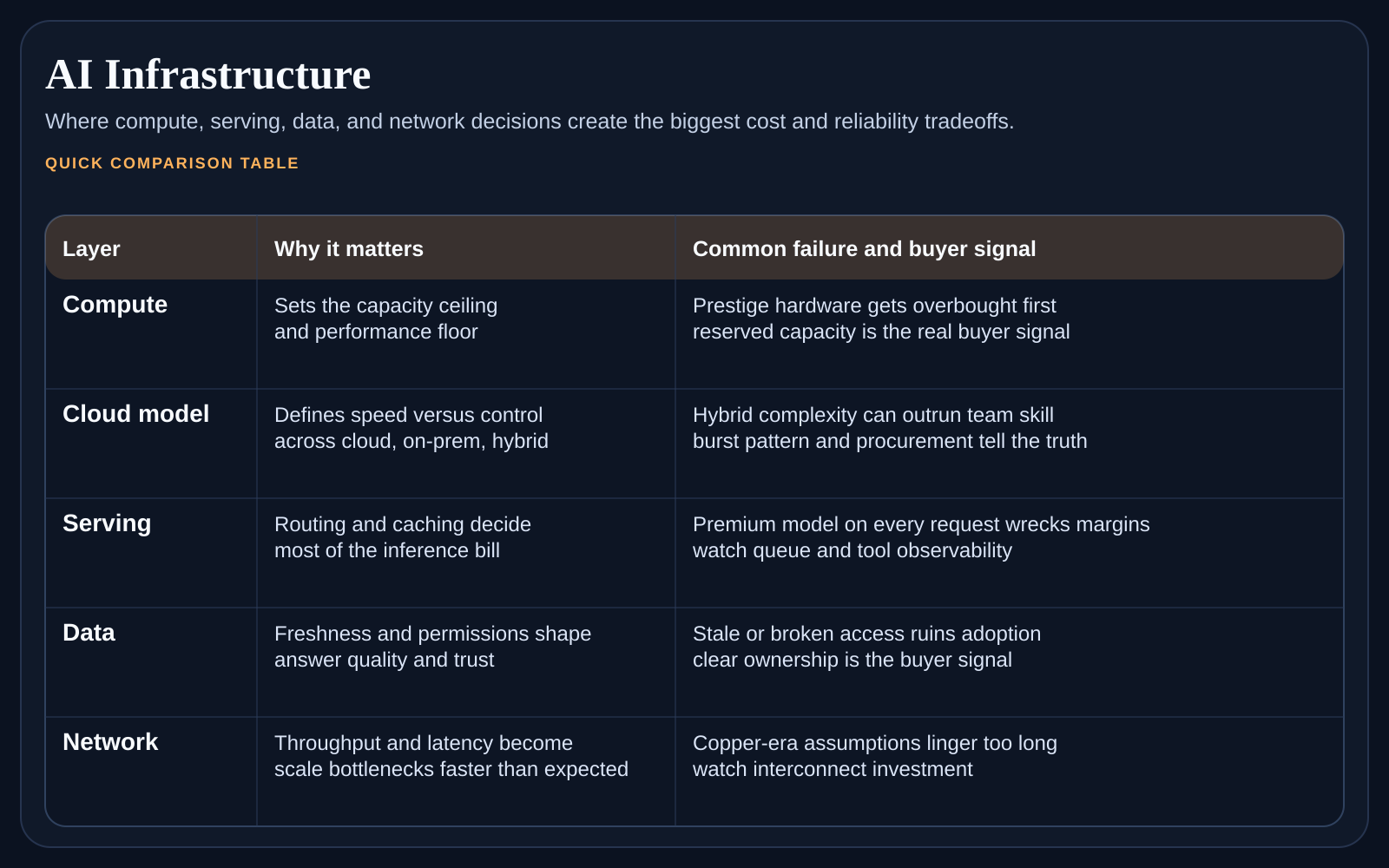
The key point is that inference cost is usually a systems problem, not a single-hardware problem. Routing, batching, retries, caching, model selection, and traffic spikes often matter as much as the accelerator underneath the request. Teams that keep looking for one magic hardware answer usually miss the bigger savings.
What drives AI inference cost most often
How often the product sends premium requests that could have been handled by a cheaper tier.
How much token waste comes from oversized prompts, duplicated context, or repeated failures.
How well the system batches work and routes low-urgency traffic away from the premium path.
How many extra tool calls, validation loops, and retries the product adds around each answer.
What drives AI inference latency most often
Queueing and congestion during bursts, especially when interactive and background traffic share the same path.
Network distance and data movement between serving layers, storage, and dependent services.
Cold-start or spin-up delays when the stack is scaled too tightly for real demand swings.
Overly complex orchestration that turns one user request into many serialized internal steps.
How to diagnose an inference spend problem
Check whether premium models are serving low-value traffic that could move to a cheaper route.
Measure retries, tool loops, and token waste before blaming hardware prices first.
Separate interactive traffic from background work so queueing and latency do not contaminate the whole system.
Then decide whether the fix is routing, caching, batching, or provider choice.
How strong teams lower cost without hurting users
They classify requests by business value, use cheaper routes for low-risk work, and keep premium capacity reserved for the interactions users notice most. They also monitor actual cost per successful outcome instead of staring at token prices in isolation. That is what turns pricing strategy into product strategy.
How strong teams lower latency without overspending
They reduce unnecessary hops, keep hot paths simple, and separate background traffic from user-facing traffic. They know where queueing starts, where retries spike, and which parts of the stack create the worst tail latency. Speed comes from clearer traffic design more than from buying the fanciest hardware every time.
FAQ
What is AI inference infrastructure?
AI inference infrastructure is the serving layer that handles live model requests, including routing, caching, batching, traffic management, and the hardware path behind those requests. It is the part of the stack that decides what users feel and what the product pays.
Is inference cost mostly a hardware problem?
Usually not. Hardware matters, but routing, prompt discipline, retries, and traffic shape often do more to change the real bill.
What should teams measure first?
Start with cost per successful user outcome and latency at the critical user-facing path. Those two numbers reveal far more than raw token or instance price alone.
Where to go next
If you still need to decide which provider environment fits your team, compare Best AI Cloud Providers for Startups and Model Teams. If you want the higher-level market map first, go back to AI Infrastructure in 2026. The provider landscape is broken down further on AI Infrastructure Companies to Know in 2026.
Weekly newsletter
Get the weekly AI infrastructure brief
One email each week on chips, cloud capacity, inference cost, networking shifts, and the provider moves that affect AI builders and buyers.