AI Infrastructure Guide
Best AI Cloud Providers for Startups and Model Teams
A decision guide to the best AI cloud providers for startups and model teams, with advice on capacity access, startup fit, deployment speed, control, and when hyperscalers or GPU cloud providers make more sense.
Last reviewed May 16, 2026Record updated May 16, 2026Live now
Read this next
Use the hub for the broad capacity view, then move across the sibling pages when you need a provider shortlist or a tighter answer on inference cost.
AI Infrastructure Companies to Know in 2026
A practical guide to the providers, cloud platforms, and capacity players shaping AI infrastructure choices in 2026.
AI Inference Infrastructure: What Actually Drives Cost and Latency
A guide to the serving, routing, caching, and networking choices that decide AI inference cost and response time.
When teams search for the best AI cloud providers, the answer depends less on brand size and more on workload shape. Startups often need fast deployment, sane credits, and room to adjust. Model teams often need deeper control, more predictable capacity, and better support for unusual workloads. One provider rarely wins both profiles in the same way.
At a glance
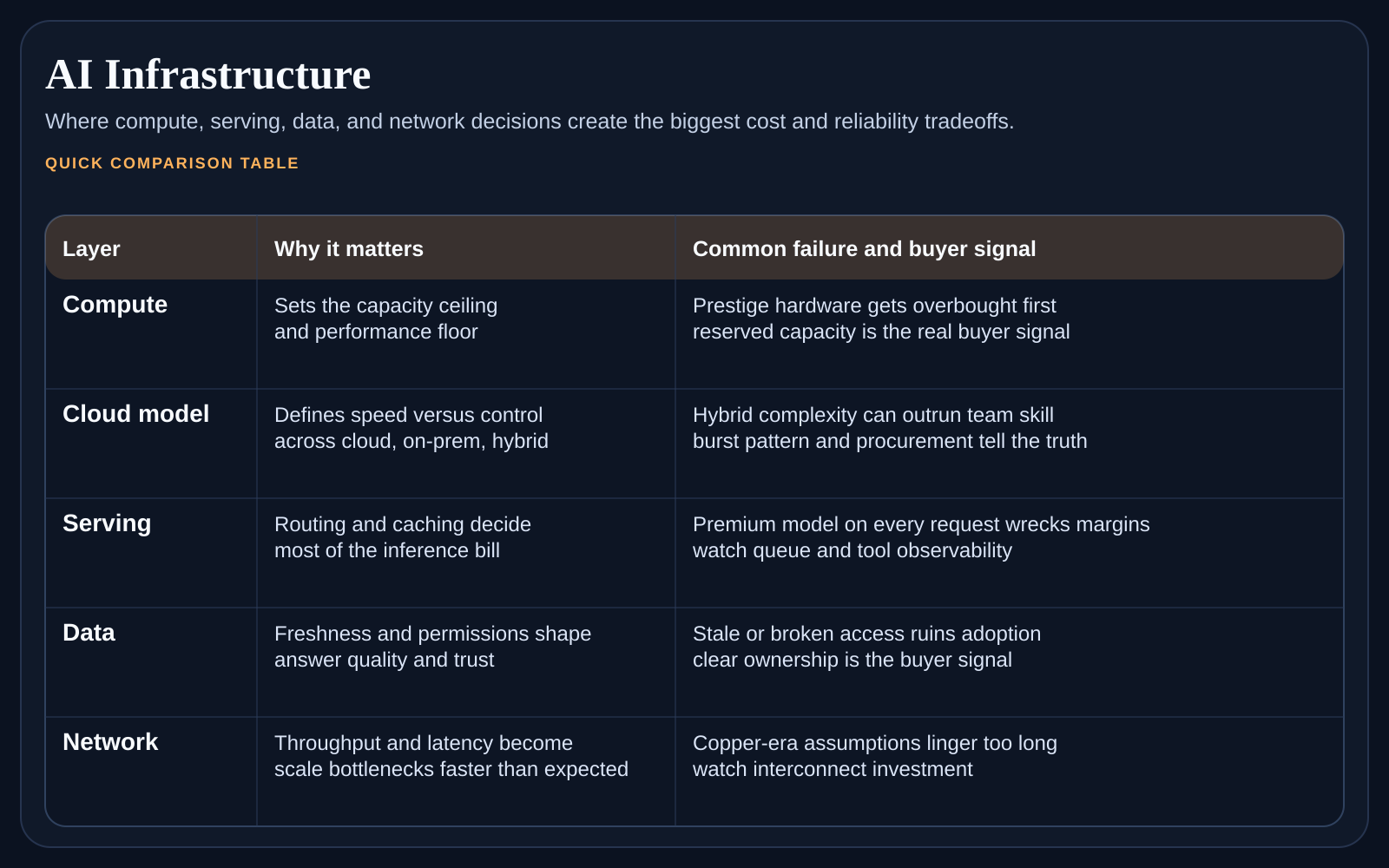
A useful split is this. Startups should usually optimize for speed to production and flexibility. Model teams should usually optimize for capacity quality, operational control, and how much friction the provider adds around training or serving changes. If you mix those goals together, every cloud pitch starts sounding equally good.
Best AI cloud providers, what startups should care about most
Time to a usable environment, not just how impressive the accelerator menu looks.
Credits, billing flexibility, and how painful it is to scale down if the first product plan changes.
Managed services and deployment help that reduce the need for a large platform team early on.
A fallback path if the most attractive instance type gets scarce or expensive.
What model teams should care about most
Reservation quality, region options, and predictable access for the workloads that matter most.
Control over scheduling, orchestration, storage layout, and serving behavior.
Support quality during incidents, not only during sales cycles.
How well the provider fits a multi-cloud or hybrid strategy once the team outgrows the first environment.
Hyperscaler versus specialist cloud
Hyperscalers are often easier to justify when the company already buys broadly from that vendor or needs a large compliance and procurement story. Specialist clouds can be the better move when focused support, faster capacity access, or a more AI-specific product path matter more than enterprise standardization. The choice is rarely ideological. It is about where the friction sits right now.
Decision shortcuts by team type
Startups usually prefer providers that get them live fast, offer credits or flexible billing, and reduce the need for a large platform team.
Model teams usually prefer providers that offer better workload control, cleaner reservation access, and fewer surprises under load.
Enterprises usually prefer providers that fit existing contracts and compliance expectations, even when a specialist cloud looks faster on paper.
If your workload mix is changing fast, favor providers that make migration and secondary-provider backup less painful.
A better evaluation process
Ask each provider to support one real workload plan, not a generic benchmark story. Compare setup time, pricing shape, monitoring, incident path, and how the provider handles the instance types you are most likely to depend on. A cloud that looks slightly weaker on marketing claims can still be the better partner if it helps your team move with less operational drag.
Comparison matrix that catches most bad decisions
Capacity access: how reliably can the provider deliver the exact accelerator and region you need during peak periods.
Pricing shape: credits, committed spend, burst pricing, and what happens when the first architecture plan changes.
Deployment friction: time to first production workload, default observability, and incident workflow quality.
Control and portability: scheduling control, serving flexibility, and how painful a second-provider fallback will be later.
Score providers against this matrix with one real workload plan. That avoids the common trap where teams buy on headline benchmark claims and discover the operational burden only after launch.
FAQ
Are GPU cloud providers better than hyperscalers for startups?
Not automatically. GPU cloud providers can win on focus and capacity access, while hyperscalers can win on credits, compliance, and broader product fit. The better choice depends on whether the startup needs speed, simplicity, or tighter long-term vendor alignment.
Should startups avoid hyperscalers entirely?
No. Some startups still win on a hyperscaler if the credits, compliance, or adjacent product stack matter enough. The point is to test real fit, not follow a slogan.
What should break a tie between two cloud providers?
Use support quality, incident behavior, and the likelihood of getting the capacity you actually need. Those factors often matter more than marginal benchmark differences.
What to read next
If you need a clearer company map before comparing providers, step back to AI Infrastructure Companies to Know in 2026. If your biggest concern is what happens after inference traffic is live, continue to AI Inference Infrastructure: What Actually Drives Cost and Latency.
Weekly newsletter
Get the weekly AI infrastructure brief
One email each week on chips, cloud capacity, inference cost, networking shifts, and the provider moves that affect AI builders and buyers.