Enterprise AI Resource Cluster
AI Rollout Checklist for Mid-Sized Companies
An AI rollout checklist for mid-sized companies, with staged guidance on ownership, workflow selection, change management, and scaling beyond one successful pilot.
Last reviewed May 16, 2026Record updated May 16, 2026Live now
Read this next
Use the hub for the full framework, then move across the sibling pages that cover workflow fit, governance requirements, and rollout order.
Enterprise AI Use Cases for Finance and Operations
A practical guide to where enterprise AI is landing first in finance, planning, supply chain, and operations work.
Enterprise AI Governance Checklist for 2026
A checklist for audit trails, approvals, identity controls, and policy decisions that shape enterprise AI rollouts.
If you need an AI rollout checklist for a mid-sized company, the problem is usually not model selection first. It is sequence. One team starts experimenting, another worries about policy, and leadership asks for companywide results before there is a stable process. This guide is meant to fix that order.
At a glance
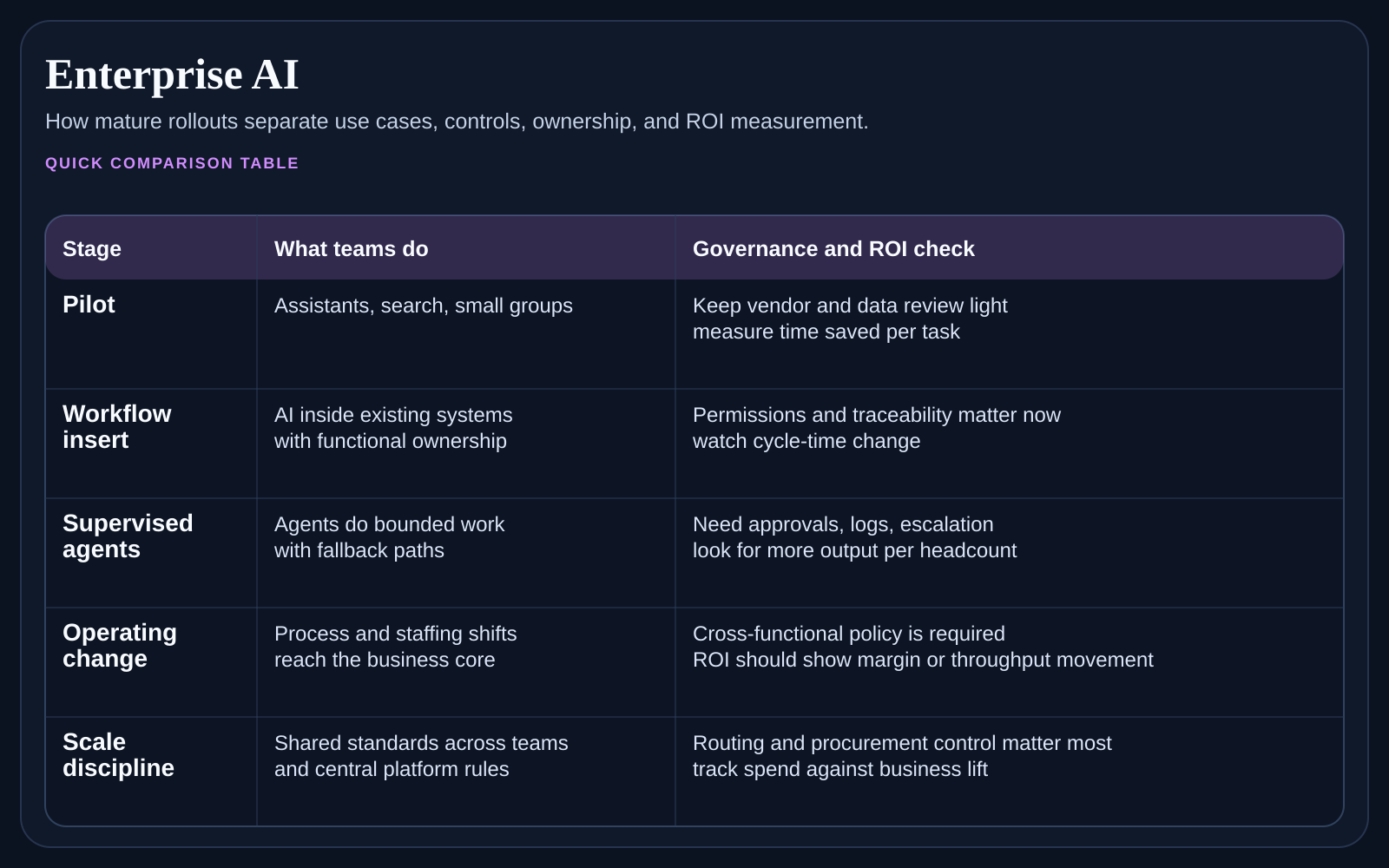
The right rollout plan for a mid-sized company is rarely companywide on day one. It is a staged program that picks a narrow workflow, sets ownership, trains the people who will review outputs, and expands only after the team can explain both the gains and the limits in plain language.
AI rollout checklist, phase one
Pick one executive sponsor and one day-to-day owner.
Choose one workflow family with a clear business pain point and a manageable review path.
Set tool access and approval rules before seats spread through the company informally.
Define success in operational terms such as turnaround time, exception rate, or time saved per task.
AI rollout checklist, phase two
Keep the pilot small enough that reviewers can inspect outputs without resentment.
Meet weekly with the functional owner to review wins, misses, and workflow friction.
Track where the AI output helps, where it creates rework, and where the process itself still blocks progress.
Write down prompt, approval, and fallback practices so the pilot is teachable, not personality driven.
A 90-day rollout path
Days 1 to 30: set ownership, choose one workflow, and define the operational metric that will decide whether the pilot is worth keeping.
Days 31 to 60: run the pilot with weekly review, capture failure cases, and document prompt and approval practices.
Days 61 to 90: decide whether to scale, revise, or stop based on workflow results rather than executive enthusiasm alone.
Phase three, expand without losing control
Expansion should happen only after the company can answer three questions cleanly: what the workflow saves, who owns the policy, and how failures get caught. If those answers are still muddy, more seats and more use cases only spread the uncertainty.
Mistakes mid-sized companies should avoid
Do not promise a companywide AI strategy before one team can show repeatable value.
Do not let every department buy a different tool before identity, security, and support rules are settled.
Do not treat training as a launch-week event. Teams need operating guidance as the workflow changes.
Do not scale a pilot that only worked because one expert user babysat every output.
FAQ
What should an AI rollout checklist include first?
The first items should be ownership, one target workflow, approval rules, and a metric that decides whether the pilot is worth keeping. Without those four pieces, the rest of the checklist turns into process theater.
How many pilots should a mid-sized company run at once?
Usually one or two. More than that makes it harder to tell whether success came from the workflow, the team, or random enthusiasm.
When should leadership announce a broader AI program?
After the first pilot has a credible operating story, not before. Announcing too early creates pressure to scale an unclear process.
How this page fits the broader cluster
If you need stronger workflow ideas before building the rollout plan, read Enterprise AI Use Cases for Finance and Operations. If legal, security, or audit concerns are slowing expansion, pair this page with Enterprise AI Governance Checklist for 2026. The hub page at Enterprise AI in 2026 ties those pieces together.
Weekly newsletter
Get the weekly enterprise AI brief
One email each week on enterprise copilots, governance shifts, rollout lessons, and vendor moves that affect operators.