Enterprise AI Resource Cluster
Enterprise AI Use Cases for Finance and Operations
A search-intent focused guide to the best enterprise AI use cases in finance, planning, operations, and process-heavy back-office work.
Last reviewed May 16, 2026Record updated May 16, 2026Live now
Read this next
Use the hub for the full framework, then move across the sibling pages that cover workflow fit, governance requirements, and rollout order.
Enterprise AI Governance Checklist for 2026
A checklist for audit trails, approvals, identity controls, and policy decisions that shape enterprise AI rollouts.
AI Rollout Checklist for Mid-Sized Companies
A rollout checklist for mid-sized companies deciding where to start, how to govern access, and how to phase adoption without adding noise.
When leaders search for enterprise AI use cases, they usually do not need a list of fifty ideas. They need to know which enterprise AI use cases are earning trust first. In most companies, that means finance and operations work with clear handoffs, known source systems, and measurable cycle times.
At a glance
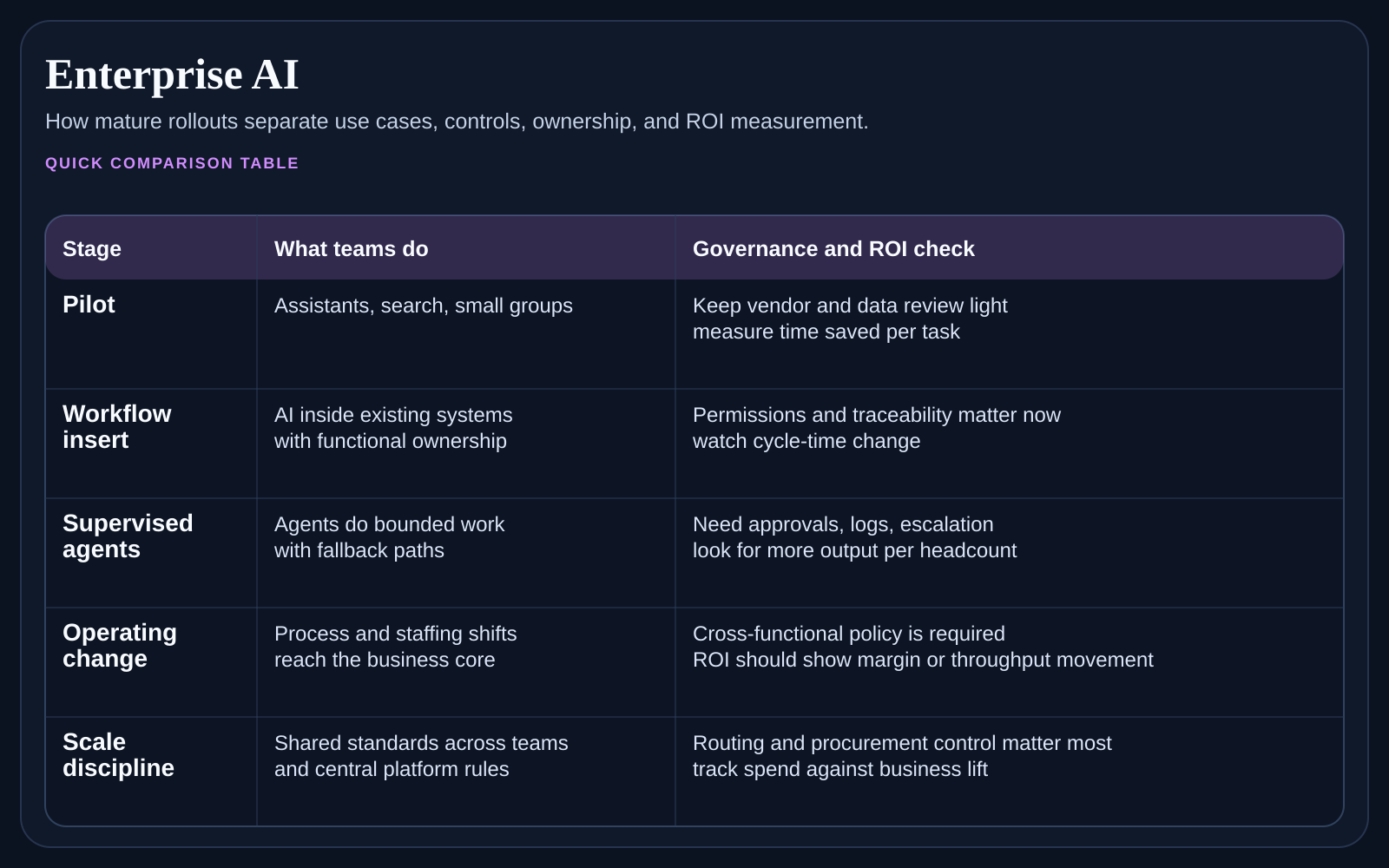
The best first-wave enterprise AI use cases are not the most glamorous ones. They are the tasks where teams already follow a repeatable process, touch the same documents every week, and can tell the difference between a good output and a risky one without starting a philosophy debate.
Best enterprise AI use cases for finance and operations
Finance close and reconciliation work that involves repeatable document review, coding, and exception triage.
Forecasting and planning support where analysts need faster scenario assembly, variance explanation, and commentary drafts.
Procurement and supply chain coordination where teams spend time chasing approvals, matching records, and escalating exceptions.
Sales and service operations where AI can summarize activity, flag risk, and prep next actions inside existing workflow systems.
Why these enterprise AI use cases beat broad copilots
They have a tighter path from AI output to business result. If the workflow already has approvals, owners, and source data, an AI layer can remove manual steps without asking the company to change everything else around it. That makes finance and operations a better proving ground than open-ended knowledge work for many firms.
How to choose the right first use case
Pick a workflow with visible pain, not a workflow that only sounds strategic in a steering-committee meeting.
Choose a process where the input data already exists in a system the AI layer can access safely.
Avoid starting with tasks that require large policy changes before you can even measure results.
Make sure a functional owner agrees to review outcomes weekly during the pilot period.
A quick scorecard for first-wave use cases
High priority: document-heavy processes with repeatable steps, stable inputs, and obvious definitions of a correct output.
Medium priority: workflows with clear value but more exceptions, where AI can still help if reviewers stay close.
Low priority: highly political or constantly changing work where success is hard to define and ownership is fuzzy.
Avoid first: use cases that require major data cleanup or major policy redesign before the pilot can even run.
Signals that a use case is not ready
If the data lives in scattered inboxes, if nobody agrees on what a correct output looks like, or if the process changes every week, the use case probably is not ready for a first rollout. Those conditions create false negatives because the pilot fails for workflow reasons rather than model reasons.
FAQ
What are the best enterprise AI use cases to start with?
The best starting use cases are repeatable, document-heavy workflows with clear review paths and measurable cycle times. Finance close, reconciliation, forecasting support, procurement coordination, and operations reporting often fit that pattern better than broad assistant deployments.
Why do finance and operations show up so often in enterprise AI examples?
Because those teams often have structured inputs, repeatable review paths, and measurable cycle times. That makes it easier to prove value without guessing.
Should customer support outrank back-office use cases?
Only if the support workflow is already well-instrumented and tightly reviewed. Otherwise back-office processes are often the safer place to build trust first.
What to read after mapping use cases
Once you know the likely first-wave workflows, move to Enterprise AI Governance Checklist for 2026 so the controls match the risk. Then use AI Rollout Checklist for Mid-Sized Companies to sequence the rollout in a way the business can absorb.
Weekly newsletter
Get the weekly enterprise AI brief
One email each week on enterprise copilots, governance shifts, rollout lessons, and vendor moves that affect operators.