Enterprise AI Resource Cluster
Enterprise AI Governance Checklist for 2026
A practical enterprise AI governance checklist for 2026, covering ownership, identity, audit trails, approval design, model access, and the controls that matter before scale.
Last reviewed May 16, 2026Record updated May 16, 2026Live now
Read this next
Use the hub for the full framework, then move across the sibling pages that cover workflow fit, governance requirements, and rollout order.
Enterprise AI Use Cases for Finance and Operations
A practical guide to where enterprise AI is landing first in finance, planning, supply chain, and operations work.
AI Rollout Checklist for Mid-Sized Companies
A rollout checklist for mid-sized companies deciding where to start, how to govern access, and how to phase adoption without adding noise.
Enterprise AI governance is not paperwork for its own sake. It is the operating system that keeps an AI rollout from turning into shadow tooling, unclear accountability, and fragile trust. This page is written for teams that already see demand building and need to know which controls belong in place before usage grows, especially if they are searching for an enterprise AI governance framework or checklist they can actually use.
At a glance
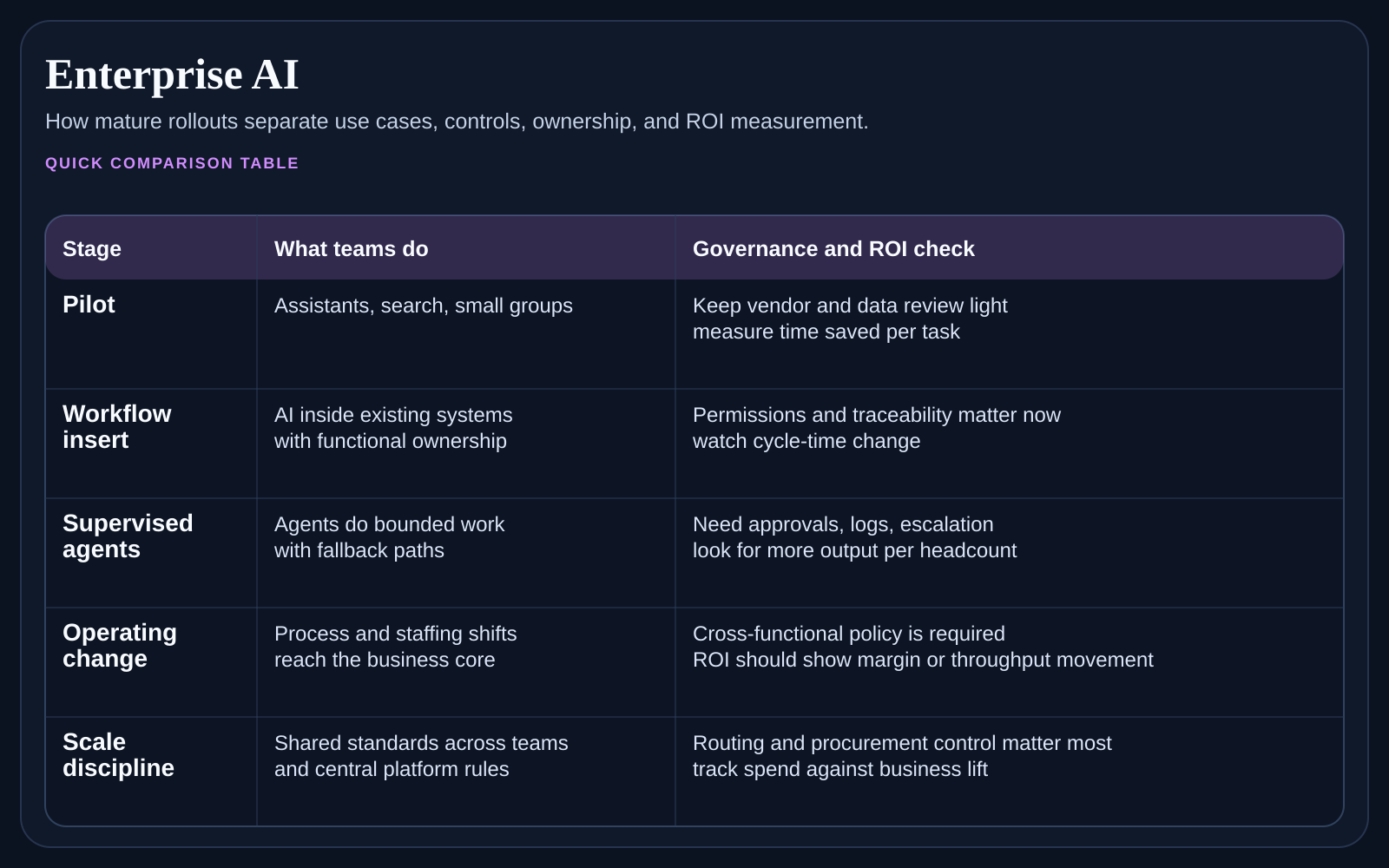
The core idea is simple. Good governance does not try to answer every future policy question on day one. It establishes ownership, access, logging, and review standards early enough that the company can expand safely once the first workflows show value.
Enterprise AI governance checklist
Name an executive owner and an operating owner. One protects business alignment. The other keeps the rollout moving week to week.
Define model and tool access rules by role, team, and data sensitivity. Do not leave access decisions to ad hoc requests.
Require logging for prompts, outputs, approvals, and meaningful workflow actions where the system can affect business decisions.
Document which workflows need human approval before an AI action is accepted, sent, or committed to a system of record.
Set escalation paths for policy exceptions, bad outputs, and system failures so teams know what happens after something goes wrong.
Rollout-ready governance template
Ownership matrix: name the executive sponsor, operating owner, security reviewer, and legal reviewer for each workflow.
Decision matrix: define what AI can draft automatically, what requires human approval, and what must remain read-only.
Access matrix: map data sensitivity tiers to model/tool access so teams know what is allowed before pilot seats expand.
Audit matrix: define which prompt/output events are logged, where logs are retained, and who can review incidents.
Teams that treat governance as a template they can fill in and run every week usually move faster than teams that only publish a policy memo. The template makes ownership and approval paths visible before incident pressure rises.
What many enterprise AI governance checklists miss
They focus on model risk and forget operating risk. A company can pick a strong model and still fail because nobody owns identity mapping, workflow approvals, or retention rules. Governance has to cover the process around the model, not only the model itself.
Minimum viable governance stack
One named executive sponsor, one operating owner, and one clearly defined escalation path.
Role-based access rules so sensitive workflows do not depend on ad hoc seat grants.
Prompt and output logging on the workflows that could change business records or customer outcomes.
A review rule that states when a human must approve, when an AI output can draft, and when the system must stay read-only.
How strict should controls be at the start
Tighter than the average pilot, but lighter than a fully mature program. Early controls should be strong enough to protect sensitive workflows and generate clean audit history. They should still leave room for supervised experimentation in lower-risk cases. The goal is confidence with movement, not a policy museum.
Questions to settle with legal and security early
Which data classes can be used in prompts or agent context without special approval.
Which logs need retention, who can inspect them, and how the company will handle incident review.
Which model providers, hosting routes, or feature types require separate approval before production use.
Which teams can pilot new AI tools independently and which teams need central review first.
FAQ
What does enterprise AI governance need at minimum?
At minimum, it needs named owners, role-based access rules, logging for high-impact workflows, review rules for when humans must approve outputs, and a clear escalation path when something goes wrong.
Is governance only relevant for regulated industries?
No. Any company that lets AI touch customer communication, internal approvals, or system-of-record data needs governance. Regulation only changes how strict it must be.
What is the most common governance mistake?
The most common mistake is letting access spread before ownership and logging are defined. That creates a cleanup project instead of a rollout.
Where to go from here
If you still need to decide which workflow deserves this governance effort first, go back to Enterprise AI Use Cases for Finance and Operations. If you have the use case and the controls, move to AI Rollout Checklist for Mid-Sized Companies to turn governance into a rollout plan instead of a static checklist.
Weekly newsletter
Get the weekly enterprise AI brief
One email each week on enterprise copilots, governance shifts, rollout lessons, and vendor moves that affect operators.