AI Coding Agent Guide
OpenAI Codex vs Cursor vs Devin
An OpenAI Codex vs Cursor vs Devin guide for teams choosing between editor speed, terminal control, delegated execution, and the review load each product creates.
Last reviewed May 16, 2026Record updated May 16, 2026Live now
Compare this next
Use the hub for the market view, then move across the sibling comparisons that answer the next tool choice your team will face.
If you are searching OpenAI Codex vs Cursor vs Devin, you are usually not asking for a trivia answer. You are trying to decide how much of the software workflow the tool should own. These three products are often compared in one breath, but they solve different problems and create different review habits once a team moves past a short demo.
At a glance
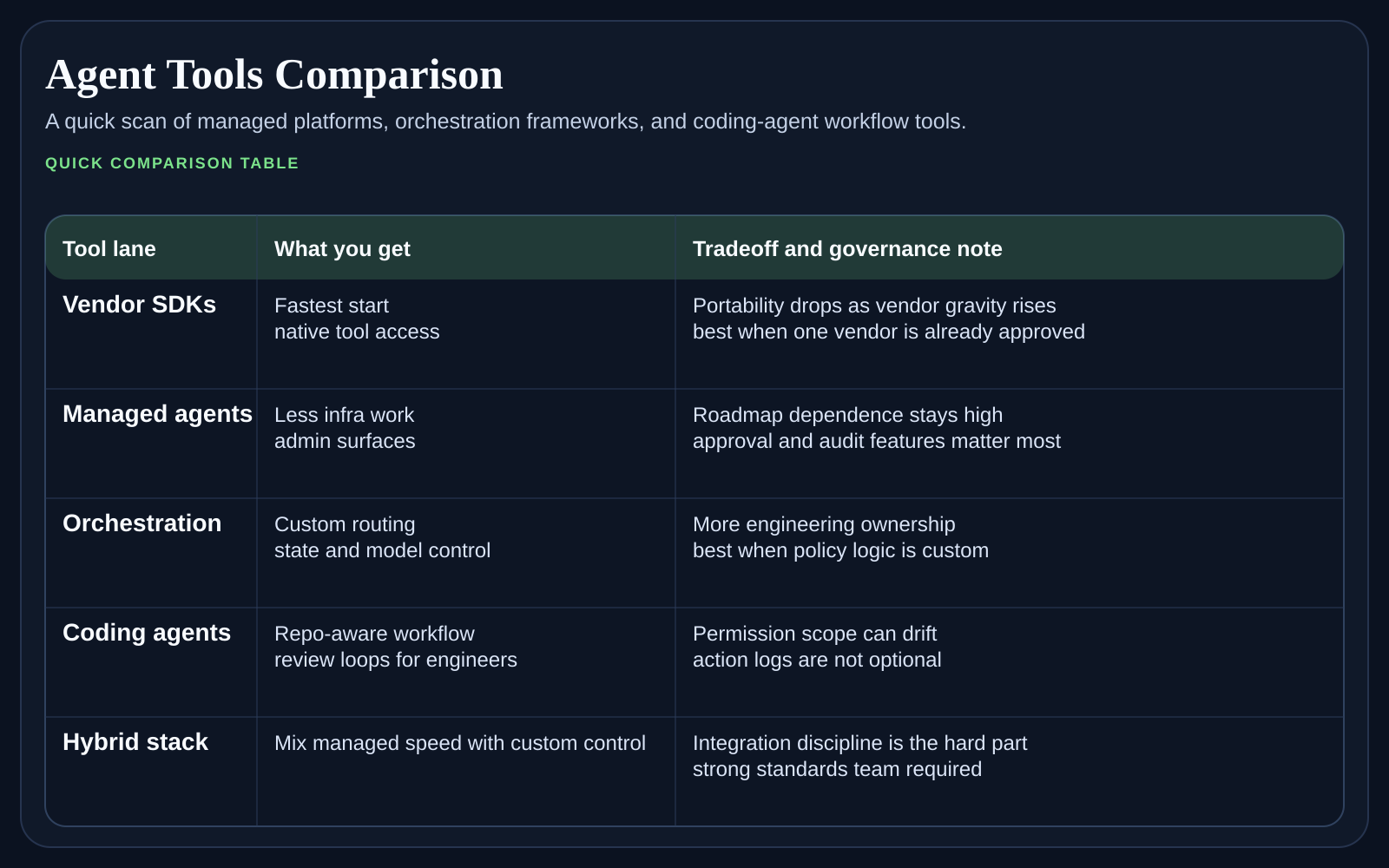
A quick framing helps. Cursor is strongest when you want an AI-heavy editor that still feels close to daily coding. Codex makes more sense when the terminal and repo state matter as much as the prompt window. Devin fits buyers who are willing to move further toward managed delegation and then invest in careful review rules around that choice.
When Codex is usually the better fit
Codex tends to win when teams want command-line control, reproducible execution, and a workflow that feels closer to engineering operations than chat-based pair programming. It is attractive for repo work that depends on scripts, tests, local tooling, and clear boundaries between planning, execution, and review.
When Cursor is usually the better fit
Cursor is the stronger option when the organization wants the shortest path from editor adoption to visible speed gains. It suits product engineers who live inside the IDE, want inline assistance and agent help in the same place, and do not want to redesign the workflow around terminals, sandboxes, or separate execution surfaces on day one.
When Devin is usually the better fit
Devin is worth serious consideration when a team wants to assign bigger chunks of work, tolerate longer background cycles, and centralize task follow-up in a more managed environment. That can be useful for structured backlog work, but only when reviewers have time to inspect broader changes and the organization is comfortable with a more delegated operating model.
What usually decides Codex vs Cursor vs Devin
Control versus distance. Cursor keeps the human closest to the code. Devin moves furthest toward delegated execution. Codex sits between those poles with stronger command-level control.
Review unit size. Small local edits are easier to absorb than broad generated task bundles. Ask which product keeps changes inspectable for your team.
Environment dependence. Some teams need local or tightly controlled repo execution. Others prefer the convenience of a more managed service even if that adds abstraction.
Adoption friction. Editor-first tools usually spread faster. More autonomous systems demand stronger norms around prompts, handoff, and acceptance criteria.
Who usually picks each option
Codex is often the best fit for platform-minded engineering teams that want shell access, test execution, and more legible repo operations.
Cursor is often the best fit for product engineering teams that want the shortest path from trial to daily editor adoption.
Devin is often the best fit for teams experimenting with more delegated backlog work and willing to manage longer review loops.
If two groups inside the company want different answers, split the pilot instead of forcing one winner too early.
Questions to ask before you buy
Does the tool help on the kind of work your backlog actually contains, or only on clean demo tasks?
Can your team tell why the agent made a change, rerun the same step, and inspect the result without guesswork?
Will security, compliance, or repo-governance rules limit the feature set that made the demo appealing?
Who owns the review burden when the system starts taking on larger tasks each week?
FAQ
Is Codex vs Cursor vs Devin really one fair comparison?
It is a useful comparison only if you admit that the products sit at different points on the autonomy curve. The winner usually depends less on brand preference and more on how much control, delegation, and review overhead your team can absorb.
Is Cursor always the fastest choice to roll out?
It is often the fastest to get engineers using AI heavily, but that does not automatically make it the easiest company standard. Procurement, policy, and editor standardization can tilt the answer back toward a broader platform tool.
When is Devin too much tool for the job?
Devin is often too much when the team still struggles to write clear task definitions or when reviewers already feel overloaded. More autonomy magnifies messy process.
Can Codex replace an editor-first tool?
Sometimes, but not for every user. Codex can cover a lot of serious repo work, yet many developers still prefer an editor-native tool for quick local iteration and inline changes.
What most teams should do next
If your debate is really about editor adoption, compare GitHub Copilot vs Cursor next. If the hard question is terminal-first workflow and control, move to Claude Code vs Codex. If none of the products feel like an obvious match, step back to Best AI Coding Agents in 2026 and re-evaluate the category split before forcing a decision.
Weekly newsletter
Get the weekly AI coding tools brief
One email each week on Copilot, Cursor, Codex, Claude Code, pricing changes, and rollout moves that affect engineering teams.